

Governance, Risk, and Compliance (GRC) transform security from scattered activities into a centralised, measurable, and trusted program. We design and operationalise governance structures, risk frameworks, and compliance processes tailored to the needs of your organisation—linking policy to control, control to evidence, and evidence to business value. From strategy and policy architecture to third-party risk, impact assessments, awareness, and IT audits, our goal is clear: reduce risk, meet regulatory and customer expectations, and make good security easy to sustain.
Each engagement is outcomes‑focused: clear scope, actionable controls, audit‑ready artefacts, and a cadence that keeps your organisation prepared year‑round. Most importantly, we work side by side with your team to ensure governance takes root and endures beyond audits.
Why Choose CipherShield to meet Your GRC Needs
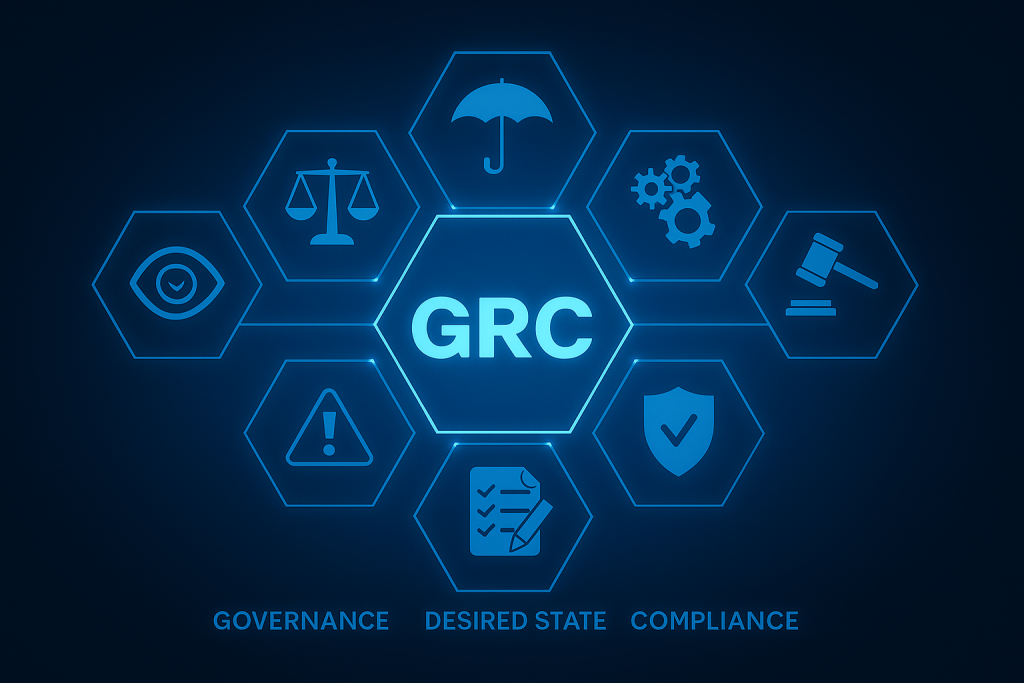
CipherShield delivers practical governance through multi-industry experience and credentials across ISO 27001, ISO 22301, ISO 27701, and ISO 42001. We help organisations align with NIST Standards and Frameworks, PCI DSS, HIPAA, SOCI Act, ISM and ASD Essential Eight, building programs that meet global standards and adapt to your actual environment – whether on-prem, hybrid, or cloud-native.
Our approach connects standards into a unified control set and evidence library, making assurance efficient and audit-ready by design. Registers, workflows, and dashboards are structured for one-time evidence capture and reuse, reducing duplicate effort and shortening audit cycles.
With CipherShield, compliance becomes simpler, measurable, and built to last.
Explore CipherShield GRC Service Offerings
Cyber Security Gap Assessments, Strategy, & Roadmaps
We begin by understanding your business objectives, risk appetite, and regulatory obligations—because a strong security strategy must serve the business, not the other way around. Our assessments benchmark your current security posture against recognised standards and frameworks such as ISO 27001, ISO 27701, ISO 22301, ISO 42001, NIST CSF v2, the ASD Essential Eight, ISA 62443 and relevant industry regulations, identifying where your controls protect you—and where gaps remain.
CipherShield then translates those insights into a clear, actionable roadmap that connects today’s gaps to tomorrow’s resilience. Each recommendation is prioritised by business impact, risk severity, and investment readiness, forming a balanced program of short‑term improvements and long‑term strategic initiatives.
The result is an executive‑ready security strategy that aligns seamlessly with your business goals, secures leadership confidence, and shows measurable progress through defined milestones, ownership, and performance metrics.
NIST Frameworks Advisory
We make NIST practical for you. We translate leading NIST frameworks into clear, auditable actions your teams can run day-to-day—so security, risk, and compliance move forward together with evidence you can defend.
CipherShield provides end-to-end advisory across:
- NIST Cybersecurity Framework (CSF) 2.0
- NIST Risk Management Framework (RMF) – NIST SP 800-37
- NIST AI Risk Management Framework - (AI RMF 1.0)
- NIST Operational Technology (OT) Security – NIST SP 800-82
- NIST Security & Privacy Controls – NIST SP 800-53
- NIST Incident Response – NIST SP 800-61
- Guidelines for Media Sanitization - NIST SP 800-88 Rev.1
A typical NIST Advisory engagement includes conducting gap assessments accompanied by a detailed remediation plan, performing a risk assessment tailored to your environment, and developing the supporting policies, standards, and procedures to manage control operations. We then assist your team in implementing and validating those controls, aligning them where appropriate with ISO/IEC 27001, ISM, and PCI DSS.
This approach ensures you receive a practical, right-sized roadmap, effective safeguards, and audit-ready evidence that clearly demonstrates measurable risk reduction.
Third-Party Risk Management (TPRM)
We help you see beyond your network perimeter by giving complete visibility into the security posture and compliance health of your suppliers. CipherShield builds risk-based TPRM frameworks tailored to your business model, regulatory obligations, and procurement cadence—ensuring the right level of assurance for every vendor.
Our structured approach includes supplier tiering, customised due‑diligence questionnaires (SIG, CAIQ, or bespoke), and systematic review of supporting evidence such as attestations, penetration tests, and ISMS documentation. Each engagement outcome is converted into actionable insights through residual risk ratings, prioritised remediation plans, and contract language that embeds accountability from day one.
Interactive dashboards track supplier risks, monitor remediation progress, and highlight renewal or exposure trends—helping procurement, legal, and security teams make faster, more informed decisions while maintaining trust across your extended ecosystem.
SOC 2 Compliance Services
We provide expert SOC 2 compliance services to help organisations strengthen security, build customer trust, and prepare for successful audits. Our tailored approach supports businesses in designing and implementing the controls needed to meet the SOC 2 Trust Services Criteria across security, availability, confidentiality, processing integrity, and privacy.
We help clients with SOC 2 readiness assessments, control gap analysis, policy development, remediation planning, evidence collection, and audit preparation. Whether you are pursuing SOC 2 Type 1 or SOC 2 Type 2, CipherShield delivers practical guidance to streamline the compliance journey and align your control environment with business goals.
Our SOC 2 consulting services are designed to reduce audit friction, improve control maturity, and support ongoing compliance. With CipherShield, you gain a trusted partner to help you achieve SOC 2 certification readiness, demonstrate security to customers, and maintain a strong compliance posture.
Incident Response (IR) Management and Table-top Exercises
We develop incident response as an operational capability rather than a document that sits unused. Our consultants design an IR plan aligned with NIST SP 800‑61 that clearly defines scope, roles and responsibilities (RACI), severity levels, decision rights, communication paths, legal and regulatory notification requirements, evidence handling, and third‑party obligations.
For the threats that matter most to your organisation – including ransomware, business email compromise, data exfiltration and privacy breaches, DDoS, insider misuse, and cloud account takeover – we create scenario‑based playbooks with concise, step‑by‑step actions for detection, containment, eradication, recovery, and lessons learned, integrated with your SIEM/SOAR and ticketing workflows.
We facilitate tabletop exercises and technical walk‑throughs using realistic injects to test executive decision‑making, cross‑team coordination, regulator and media engagement, and supplier escalation. This is complemented by focused training for IR teams and subject‑matter experts on evidence collection, chain of custody, and crisis communication, supported by quick‑reference guides and on‑brand visual aids.
The result is an audit‑ready incident response framework aligned with ISO 27001 Annex A, PCI DSS and the Essential Eight, supported by clear, usable playbooks, a defined exercise schedule with measurable readiness indicators, and structured post‑incident improvement cycles, enabling faster and more controlled responses with reduced impact and strong assurance for stakeholders and regulators.
Cyber Security Awareness & Training
We create role-based awareness programs that transform security from policy to everyday practice. Content spans fundamentals for all staff, targeted scenarios for system administrators and developers, and advanced tabletop or incident simulation exercises for leadership and incident response teams. Each module is tailored to your environment and recent risk trends, mapping directly to your policies and compliance obligations.
By combining micro-learning, visual artefacts, and metrics such as click rates, reporting trends, and policy acknowledgment, we turn awareness into measurable behavioural improvement.
IT Audits (Internal, External & IT General Controls)
Our IT audit services provide independent, risk-based assurance across platforms, processes, and control environments. Engagements assess IT General Controls, application integrity, cloud/service provider governance, and operational resilience with coverage across access, change, operations, backup, DR, and monitoring. Audit programs align with IIA standards, ISO 27001 control domains, and ITGC expectations where applicable.
Deliverables include balanced findings, defined root causes, prioritised action plans, and validation evidence for closure. This approach strengthens governance oversight while preparing your organisation for regulator, board, and customer scrutiny.
HIPAA Compliance Services
We provide compliance services for healthcare organisations, healthtech companies, SaaS vendors, and business associates that need to protect sensitive patient data and align with US healthcare privacy and security requirements. Our risk-based approach supports the design and implementation of administrative, physical, and technical safeguards aligned with the HIPAA Security Rule and Privacy Rule.
We help clients with risk assessments, gap analysis, policy and procedure development, remediation planning, workforce training, and audit readiness. Whether you are building a compliance program from the ground up or strengthening an existing framework, CipherShield delivers practical support to reduce risk, improve compliance maturity, and protect electronic protected health information (ePHI).
Our consulting services are designed to help organisations achieve and maintain compliance, demonstrate accountability, and strengthen trust with patients, customers, partners, and regulators. With CipherShield, you gain a trusted partner for HIPAA security compliance, privacy compliance, and ongoing support tailored to your organisation’s needs.
GRC as a Service (GRCaaS)
Put governance, risk, and compliance on autopilot with a dedicated CipherShield specialist embedded in your team. We provide flexible, on-demand expertise—as a virtual CISO (vCISO), strategic advisor, hands-on specialist, so you achieve real progress without the recruitment hassle.
What we manage for you:
ISO standards (27001, 27701, 42001, 22301), NIST frameworks, SOCI Act obligations, ASD Essential Eight uplift, PCI DSS alignment, Privacy and AI Governance, alignment, and tailored in-house advisory. Under NDA, we act as a trusted insider using licensed tools and auditable workflows, eliminating the need to chase admins, aggregate evidence, or manage auditors.
How it works:
- Stabilise (30-60 days): establish your baseline maturity, determine acceptable risk levels, rationalise controls, and create an evidence register.
- Operate: maintain a monthly rhythm for risk workshops, policy and standard updates, evidence validation, supplier due diligence, and audit preparation. Plus, provide a single point of contact for auditors and customers.
- Prove: deliver board-ready metrics reflecting risk reduction, control coverage, time-to-evidence, and exception closure, backed by a dynamic remediation plan with clear ownership and SLAs.
You retain strategic oversight while we handle the heavy lift, updating documentation, capturing configuration proofs, responding to audit inquiries, and driving issues to resolution, freeing your team to focus on business growth and innovation while staying consistently audit-ready.
The Benefits of a
Mature GRC Program
Stronger, Repeatable Governance
Build Trust with Customers
Lower Risk and Smarter Investment
Reduced Audit Fatigue
One evidence library supports ISO 27001, Essential Eight, PCI DSS, HIPAA, and Privacy reviews, shortening cycles and eliminating rework.

Frequently Asked Questions about GRC Services
How do you build a security strategy that executives will fund ?
We start with what matters most to leadership—business objectives, regulatory drivers, and risk appetite—before benchmarking your current capabilities. The strategy becomes a targeted, costed roadmap with ownership, KPIs, and KRIs that show measurable progress in resilience and risk reduction.
We deliver board‑ready materials with clear trade‑offs, visual risk narratives, and structured quarterly checkpoints that keep commitment and momentum high.
What does “good” policy architecture look like in practice?
A strong policy framework is concise, layered, and enforceable. It follows a logical hierarchy (policy → standard → procedure → guideline) and defines roles, exceptions, and evidence requirements clearly. The result is documentation that operators can use daily and auditors can rely on confidently.
We provide tested templates, role matrices (RACI), and a governance calendar—ensuring policies remain active, auditable, and relevant across business units.
How do you operationalise Third Party Risk Management without slowing procurement ?
We tier suppliers based on inherent risk, tailor due‑diligence questionnaires, and automate evidence collection where practical. High‑risk vendors undergo deeper technical or contractual assessments, while low‑risk suppliers follow a streamlined path.
You get a tiered, service‑level‑driven TPRM model with dashboards for procurement and information security, enabling early visibility, faster onboarding, and intelligent stop/go decisions.
What makes your awareness program different from generic training ?
Our approach goes beyond compliance slides. We design role‑based, scenario‑driven content tied to your own policies, incidents, and tools. Programs combine executive simulations, IR team exercises, and bite‑sized learning that employees actually retain.
You get awareness program that translates into quantifiable behavioural change—measured through participation, reporting rates, and audit‑ready evidence of cultural maturity.
How do you run ITGC audits without disrupting delivery ?
We scope audits to material risk, align with business delivery windows, and agree sampling upfront to avoid rework. Every finding comes with a root cause analysis and practical remediation guidelines to prevent recurrence.
You get auditor‑grade working papers, an “evidence‑to‑close” trail documented from day one, and clear communication that keeps business and audit teams aligned.
Can multiple GRC frameworks like ISO 27001, NIST CSF, Essential Eight, and PCI DSS be aligned and managed simultaneously ?
Absolutely. it is possible to integrate multiple GRC frameworks simultaneously, including ISO 27001, ISO 27701, ISO 22301, NIST CSF, and PCI DSS. By mapping and harmonizing overlapping controls and requirements, organisations can create a unified cybersecurity program that reduces duplication, streamlines compliance efforts, and improves overall security posture.
This integrated approach leverages the strengths of each framework, enabling efficient risk management, consistent policy enforcement, and simplified audit readiness across diverse regulatory and industry demands.
How do you measure GRC program success ?
We measure by outcomes—risk reduction, control maturity, evidence availability, and audit closure rates—rather than document count. We also monitor KRIs such as incident frequency and exception closure time.
You get executive‑grade dashboards and operational metrics that help both leaders and control owners see real, defensible progress.
Do you support multi country or regulated sectors ?
Yes. We integrate local privacy, financial, and critical‑infrastructure regulations within a consistent global governance model. Our approach accommodates regional nuances while maintaining a unified core across jurisdictions.
You get centralised oversight with local adaptability—producing evidence and reports that withstand global auditor and regulatory scrutiny.
How do you keep GRC sustainable after the project ends ?
We embed governance cycles that include scheduled reviews, automated evidence collection, and role‑based dashboards. Ownership is transferred through tailored runbooks and skills uplift, so security remains operational, not theoretical.
You get a GRC operating rhythm that maintains compliance, improves visibility, and runs seamlessly between audits—security that sustains itself.